

European enterprises are under increasing pressure to develop workforce capabilities while managing operational risk, skills shortages, digital transformation and changing regulatory expectations.
Traditional training methods remain valuable, but they do not always provide employees with sufficient opportunities to practise complex tasks, respond to realistic workplace situations or apply knowledge within the context of their roles.
This is where enterprise immersive learning can provide measurable value.
Using technologies such as virtual reality, augmented reality, mixed reality and interactive simulations, immersive learning places employees inside realistic scenarios where they can practise decisions, develop technical skills and receive immediate feedback.
Extended reality is already being applied across manufacturing, construction, healthcare, education, industrial operations and workforce training. The European Commission also identifies training and education as important application areas for the continued growth of XR technologies in Europe.
For enterprise decision makers, however, the question is not whether immersive technology is innovative. The more important question is where it can solve a genuine workforce or business problem.
The following five use cases demonstrate where immersive learning can deliver the greatest enterprise value.
1. Workplace Safety and Emergency Preparedness
Why Conventional Safety Training Can Be Limited
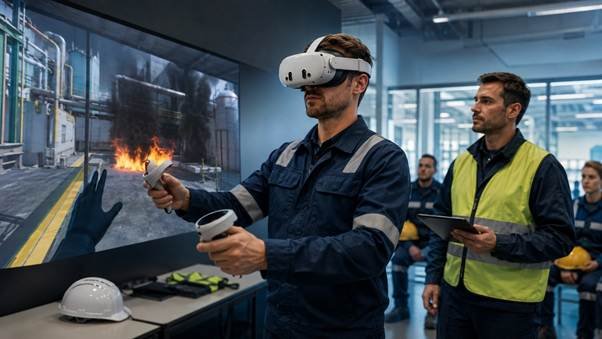
Employees working in manufacturing plants, energy facilities, construction sites, warehouses, utilities and other high-risk environments must be prepared for situations that cannot be safely recreated during conventional training.
Examples may include:
- Equipment failures
- Electrical hazards
- Fires and emergency evacuations
- Chemical leaks
- Working at height
- Confined-space incidents
- Heavy machinery interactions
Classroom training can explain procedures, while videos can demonstrate correct actions. However, neither method fully recreates the pressure, spatial awareness or decision-making required during an actual emergency.
How Immersive Learning Helps
Virtual reality allows employees to enter a controlled simulation of a hazardous environment without exposing them, their colleagues or physical assets to real danger.
Learners can identify hazards, follow emergency procedures, select appropriate protective equipment and experience the consequences of incorrect decisions. The scenario can then be repeated until the employee demonstrates the required level of competence.
European organisations are already using VR within workplace safety programmes. EU-OSHA has highlighted examples in which virtual reality supports emergency-response and industrial safety training, including implementations in telecommunications and glass manufacturing.
2. Technical Skills and Equipment Operations
The Challenge of Developing Practical Competence
Technical training often depends on access to machinery, specialist instructors, physical facilities and operational downtime.
This creates difficulties when equipment is expensive, geographically distributed, continuously operational or unsafe for inexperienced employees to use.
It can also become challenging to provide the same standard of instruction across different countries, facilities and language groups.
How Immersive Learning Helps
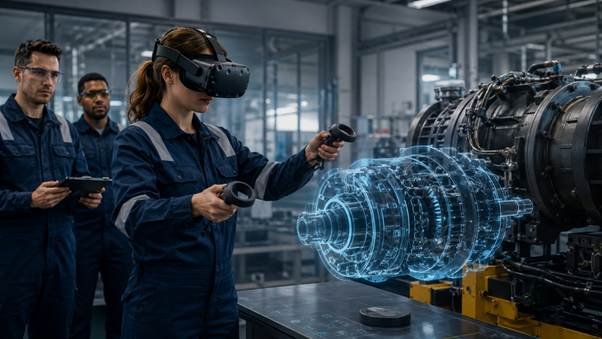
A virtual simulation can recreate machinery, control panels, production environments and operational procedures in a realistic digital setting.
Employees can practise:
- Equipment start-up and shutdown
- Inspection procedures
- Fault identification
- Maintenance activities
- Assembly and disassembly
- Troubleshooting
- Standard operating procedures
Augmented reality can support employees within the actual workplace by presenting instructions, diagrams, warnings or reference information over physical equipment.
Mixed reality can take this further by allowing employees to interact with digital components positioned within the real environment.
The objective should not be to reproduce every piece of equipment in XR. Enterprises should prioritise procedures where errors are expensive, dangerous or operationally disruptive.
3. Employee Onboarding and Process Standardisation
Why Enterprise Onboarding Often Produces Inconsistent Results
Large organisations frequently employ people across multiple offices, plants, countries and business units. As a result, onboarding quality may depend on the availability of local managers, trainers or experienced colleagues.
Employees may receive different interpretations of the same procedure, particularly when workplace knowledge is transferred informally.
This can affect productivity, compliance, employee confidence and time to competence.
How Immersive Learning Helps
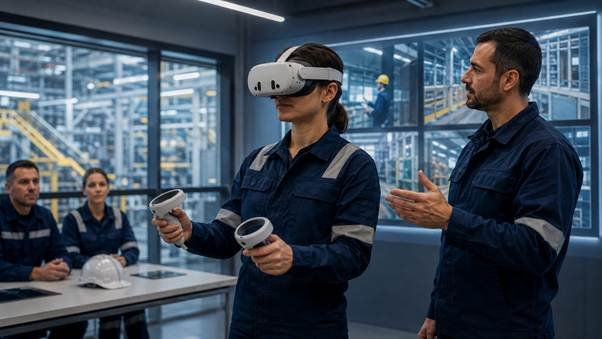
Immersive onboarding can introduce employees to their workplace before they physically enter it.
A learner could virtually explore a production facility, understand site-specific risks, meet digital representations of key stakeholders or complete a simulated first-day workflow.
Scenario-based simulations can also help employees practise organisational processes such as:
- Reporting an incident
- Responding to a customer request
- Following an escalation procedure
- Conducting a quality inspection
- Handling confidential information
- Collaborating across departments
The same experience can be delivered across the organisation while allowing content to be localised for different markets, languages and regulatory requirements.
Immersive onboarding is most effective when combined with manager support, workplace practice, digital learning resources and structured performance feedback.
4. Leadership, Communication and Customer-Facing Skills
The Difficulty of Practising Human Interactions
Leadership and interpersonal skills are traditionally developed through workshops, role-play, coaching and on-the-job experience.
These methods can be effective, but learners may feel uncomfortable practising difficult conversations in front of colleagues. The quality of role-play can also vary depending on the facilitator and participants.
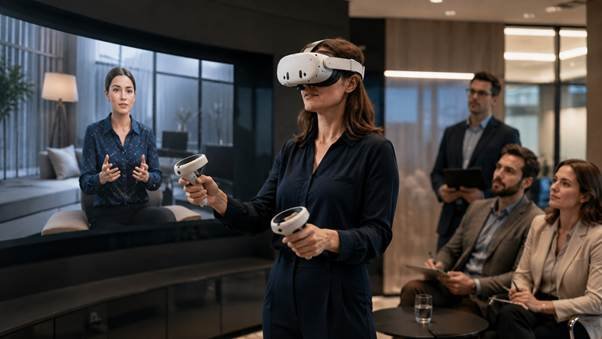
How Immersive Learning Helps
Virtual scenarios allow employees to interact with realistic characters in situations such as:
- Providing performance feedback
- Managing workplace conflict
- Leading organisational change
- Responding to customer complaints
- Conducting sales conversations
- Supporting an employee experiencing difficulty
- Making decisions under pressure
Learners can explore different responses and observe how their choices affect the conversation. They can then repeat the scenario using a more effective approach.
Research conducted by PwC found that VR-based soft-skills learners completed training faster and reported greater confidence in applying what they had learned than classroom participants in the study. However, the value of these results depends on programme design, learner volume and how effectively the technology is integrated into a wider learning strategy.
Immersive learning does not replace coaching or human interaction. It provides a structured practice environment before employees apply their skills in real workplace conversations.
5. Remote Assistance and Expert Knowledge Transfer
The Growing Risk of Knowledge Loss
Many European organisations are managing ageing workforces, specialist talent shortages and increasing demand for advanced technical skills.
Cedefop continues to identify skills development, lifelong learning and workforce capability as important factors in addressing labour shortages and supporting Europe’s digital and green transitions.
When experienced employees retire or leave an organisation, valuable knowledge may disappear with them. Written manuals cannot always capture the judgement, sequence awareness and practical problem-solving used by experienced specialists.
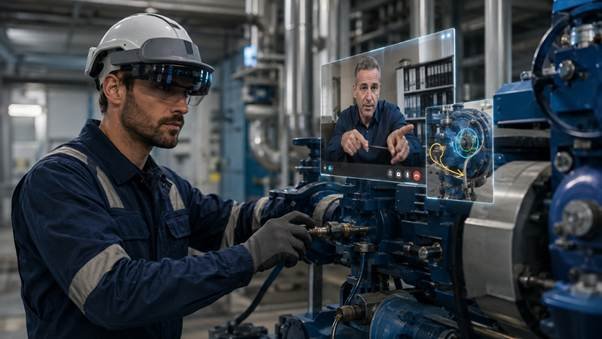
How Immersive Learning Helps
Augmented and mixed reality can connect a field employee with a remote expert who can view the situation and provide visual guidance.
Instructions, annotations or component information can be presented within the employee’s field of view, reducing the need for the expert to travel to the site.
Organisations can also capture expert procedures and convert them into reusable immersive training experiences. A specialist’s knowledge can therefore support future employees even when that individual is no longer available to conduct every training session.
This approach is especially relevant to utilities, manufacturing, engineering, transport, energy, field services and infrastructure organisations.
Choosing Between VR and AR
Enterprise immersive learning should begin with the performance requirement, not the device.
Virtual Reality
VR is suitable when learners need to enter a fully simulated environment.
It is particularly effective for hazardous situations, equipment simulations, emergency response, soft-skills scenarios and workplace familiarisation.
Augmented Reality
AR is useful when digital information needs to support an employee within the physical workplace.
It can provide step-by-step instructions, equipment information, inspection guidance or remote expert support through compatible devices.
What Decision Makers Should Evaluate Before Investing
A successful enterprise immersive learning initiative requires more than selecting XR hardware.
Decision makers should assess five areas.
Business Relevance
The selected use case should address a clear operational, safety, capability or performance problem.
Learning Suitability
Immersive learning is most valuable when employees need to practise actions, decisions, interactions or spatial procedures. It may not be necessary for simple information transfer.
Scalability
Organisations should consider device management, deployment locations, localisation, technical support, content updates and integration with existing learning platforms.
Measurement
The programme should generate evidence of performance improvement. Possible measures include task accuracy, completion time, procedural errors, learner confidence, incident rates and time to competence.
Responsible Implementation
XR deployments must consider accessibility, employee wellbeing, privacy, ergonomics and appropriate usage duration. EU-OSHA has noted that virtual and augmented reality technologies can create physical and ergonomic risks if they are not introduced carefully.
A human-centred implementation approach is therefore essential.
Moving from an Immersive Learning Pilot to Enterprise Scale
Many organisations begin with a small technology demonstration that creates initial interest but does not progress into a scalable learning programme.
To avoid this, enterprises should follow a structured approach:
- Identify a high-value performance problem.
- Define the behaviours employees must demonstrate.
- Select the most appropriate immersive technology.
- Develop a focused pilot around measurable outcomes.
- Test the experience with representative users.
- Compare performance before and after training.
- Refine the solution based on evidence.
- Create a deployment, governance and content-maintenance plan.
The strongest business case usually comes from solving one important problem successfully before expanding immersive learning across additional roles or locations.
Immersive Learning as an Enterprise Capability
Immersive learning should not be viewed as a replacement for all classroom training or digital learning.
Its value lies in providing experiences that conventional methods cannot easily reproduce, particularly when employees must practise high-risk procedures, technical operations, difficult conversations or workplace decisions.
For European enterprises, the opportunity is to connect immersive technology with wider priorities such as workforce resilience, operational safety, digital transformation and knowledge continuity.
Organisations that approach immersive learning with clear objectives, suitable governance and measurable performance indicators will be better positioned to move beyond experimentation and create lasting business value.
Build Immersive Learning Around Your Business Priorities
CHRP-EUROPE develops enterprise eLearning, virtual reality, augmented reality and mixed reality experiences designed around real workforce and operational requirements.
Our immersive learning solutions in Europe support organisations in transforming safety training, technical capability development, employee onboarding, knowledge transfer and performance-based learning.
Partner with CHRP-EUROPE to identify the right enterprise use case and develop an immersive learning solution that is scalable, measurable and aligned with your business goals.